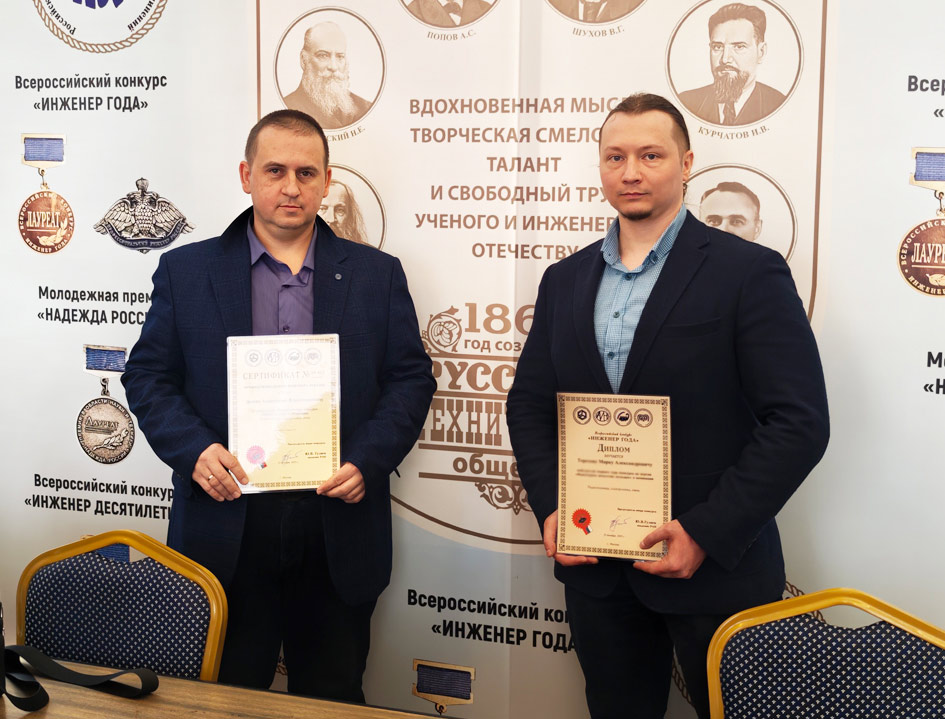
Following the 26th All-Russian “Engineer of the Year” competition, our employee Alexander was awarded the title of “Professional Engineer of Russia” and received a certificate and badge from the “Professional Engineers” awards committee. Employee Mark was awarded a diploma for “Winner of the First Round of the All-Russian “Engineer of the Year” Competition” by the “Engineering Art of the Young” awards committee. The awards ceremony for specialists from JSC NIIET (part of the Element Group, MOEX:ELMT) was held in Moscow at the “Engineering Glory” Hall of the Russian Union of Scientific and Engineering Public Associations (RosSNIO).
About the Competition
“Engineer of the Year” is the country’s largest professional achievement competition. It is organized by the Russian Union of Scientific and Engineering Public Associations, the International Union of Scientific and Engineering Public Associations, the A. M. Prokhorov Academy of Engineering Sciences, and the Interregional Public Foundation for the Promotion of Scientific and Technological Progress.
Career Path
Today, Alexander and Mark are lead engineers at NIIET. Both graduated from the Voronezh State Technical University and are building their careers in our company. Although each had their own path, they are united by perseverance, passion, and the support of mentors and colleagues—this is what the engineers themselves described.
Alexander
Alexander’s interest in engineering began in childhood, when he and his father repaired household appliances. In high school, he and his friends found a bag of radio components—a real coup in the 1990s. They studied the components, tried to assemble devices, and invent new ones. It’s no coincidence that Alexander considers Alexander Popov, a pioneer of radio communications, his professional hero.
He decided to participate in the competition after advise from his supervisor. The most challenging part was describing his own achievements, as engineers rarely think about personal accomplishments in their daily work. “You simply complete tasks, move projects forward, but writing about yourself is always difficult. But in our application, we showcased real work results—publications, developments, practical solutions,” Alexander notes.
He emphasizes that the award is the result of teamwork. He names his supervisors and senior colleagues among the mentors who played a significant role in his professional development.
Currently, his laboratory plans to implement additional user-friendly developer tools for the new microcontrollers. “These are tools and instruments that lower the entry barrier for those who want to work with our products. Developing projects using microcontrollers is a challenging task in itself, so it’s important to make it as simple and accessible as possible,” the lead design engineer concluded.
Mark
Mark joined the Research Institute of Electronic Engineering while still a student at Voronezh State Technical University. His interest in digital circuit design was sparked by a professor who brought his students to the Research Institute of Electronic Engineering for internships. After graduating, Mark decided to continue working at the institute.
Mark’s family wasn’t engineers, so choosing his future profession was a personal decision. He relies primarily on mentors in his work. Both university professors and the design center’s management played a significant role in his career development.
Mark considers the team to be the main advantage of the Research Institute of Electronic Engineering: “They help, teach, and offer advice. The work is interesting. There’s support and a high level of standards—this is important for an engineer.”
Participation in the competition was a management initiative. The most challenging part for Mark was completing the paperwork and describing the projects in detail: “There was a lot of work, and everything had to be described in detail. I’m focused on the result, not on self-presentation.”
The lead design engineer also commented briefly on the victory: “It’s good that it worked out. We need to keep working.”
Advice for young professionals
Both participants agree: the key is to choose a direction that truly interests you. Without personal involvement in your work, it’s difficult to achieve results.
Congratulation to Alexander and Mark with their well-deserved victory! Their achievements are the result of hard work, the support of their mentors, and the teamwork that makes every project at the institute special.
Today, the institute employs 19 PhDs in engineering, physics, mathematics, and chemistry, four associate professors of engineering (including two professors), and six doctoral students. Here, experience and youth, science and practice come together—a sphere in which you can learn, ask questions, and grow professionally.