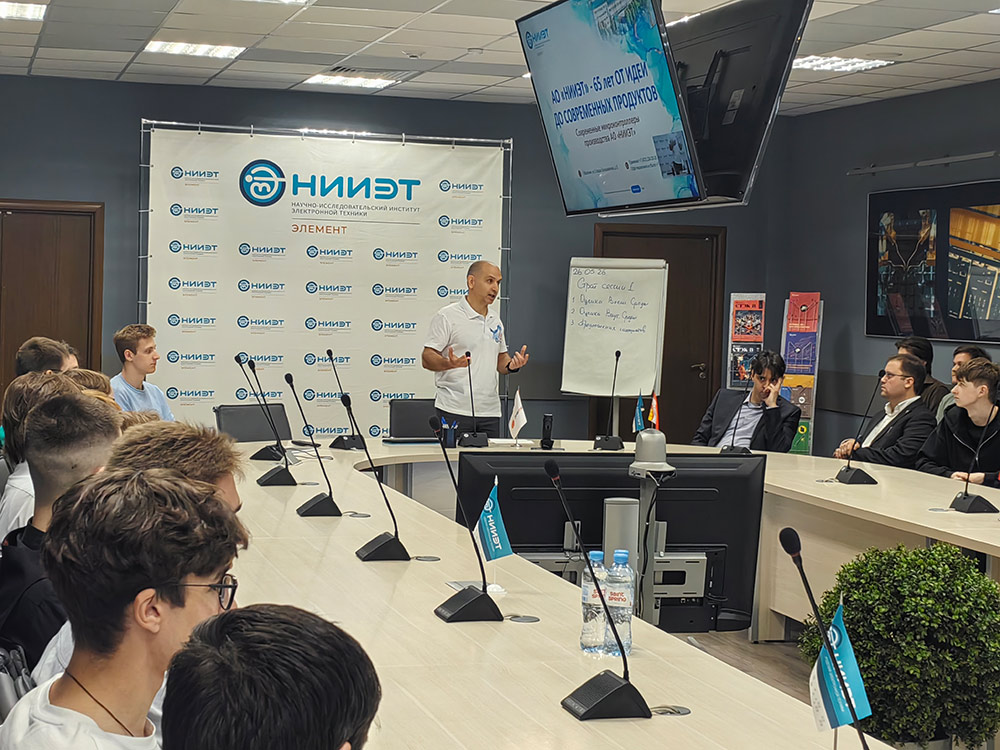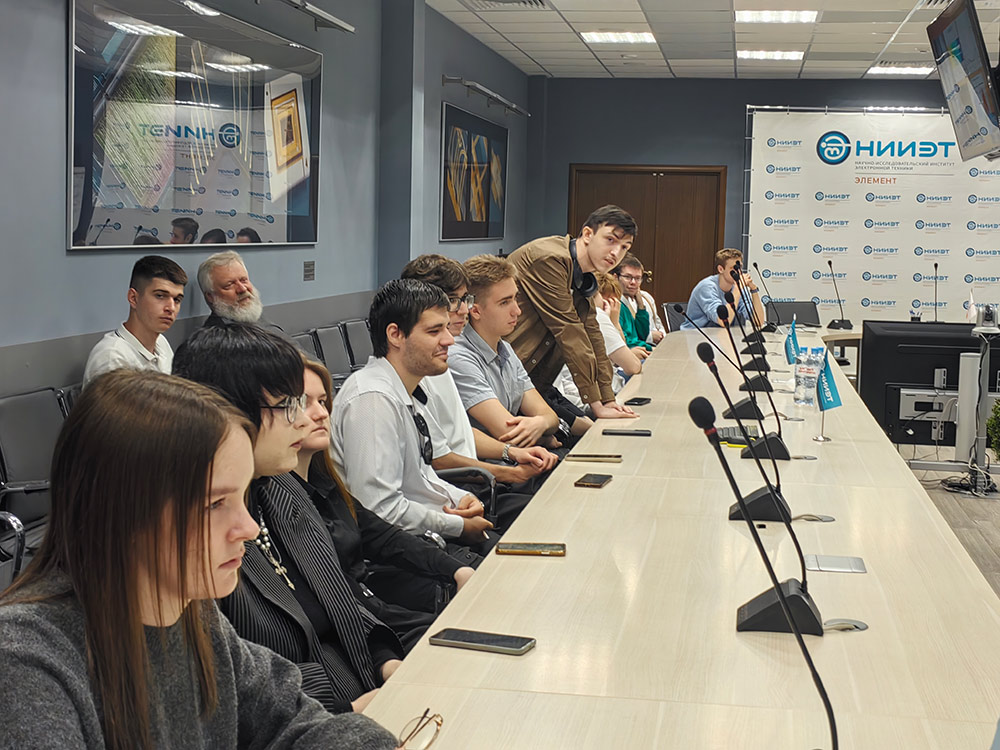
As part of the anniversary events dedicated to the 65th anniversary of the Scientific Research Institute of Electronics (NIIET, part of the Element Group, MOEX: ELMT), a unique meeting was held between the enterprise’s scientists and a new generation of scientific pioneers. The event was titled “Experience Working with NIIET Products: The Perspective of Young Researchers.”
Leading technical experts and students from regional technical universities gathered in the enterprise’s conference hall to discuss the practical application of NIIET products, specifically its microcontrollers.
The event became a lively discussion platform, as well as a clear demonstration of how theoretical knowledge is transformed into real-world projects. Students shared their experience using NIIET components in current and highly relevant fields such as the Internet of Things (IoT), the creation of smart systems, and industrial monitoring.
The technical director of JSC NIIET delivered an opening speech, sharing the history of the enterprise and reminding the audience that it was here that the first domestic integrated circuit was developed. He then presented a program providing universities with evaluation and development boards for educational and scientific activities.
A leading design engineer from NIIET in his presentation provided a brief overview of the history of developments at the IC Design Center. He spoke about the institute’s collaboration with the RISC-V Alliance and the RISC-V DEVBOARDS program, which allows for testing many Russian developments. However, the main focus of his report was on the institute’s cutting-edge products—a series of 32-bit microcontrollers based on the RISC-V architecture and evaluation boards—as well as the core principles of working with these products and the possibilities for their application in educational and project-based work.
Danil Getmantsev, a student at Voronezh State Forestry University (VSFU), presented his project titled “Creation of a Software and Hardware Radiation Control System with Automatic Radiation Type Identification Function Based on MEMS Sensors.” In his report, he discussed the feasibility of integrating the K1921VG015 microcontroller into devices with radiation type identification capabilities.
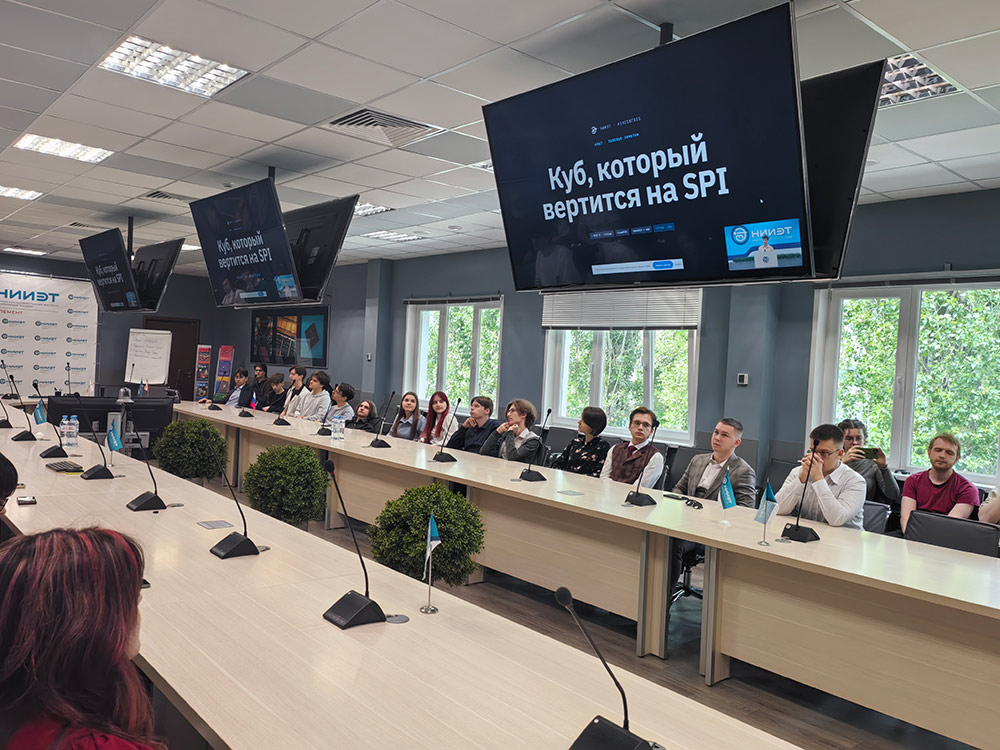
He was followed by Philipp Shtokolov, a student at Voronezh State University (VSU) and an employee at the IC Design Center, who gave a presentation titled “A Cube Spinning on SPI.” His work provided a detailed description of using an ultra-low-power NIIET microcontroller to build 3D models.
Evgeny Lyashchenko, a first-year student at Voronezh State Technical University (VSTU), concluded the session with his report, “Development of an Automated Vertical Hydroponic System,” which demonstrated the integration of the K1921VG015 into devices designed for soil-free plant cultivation.
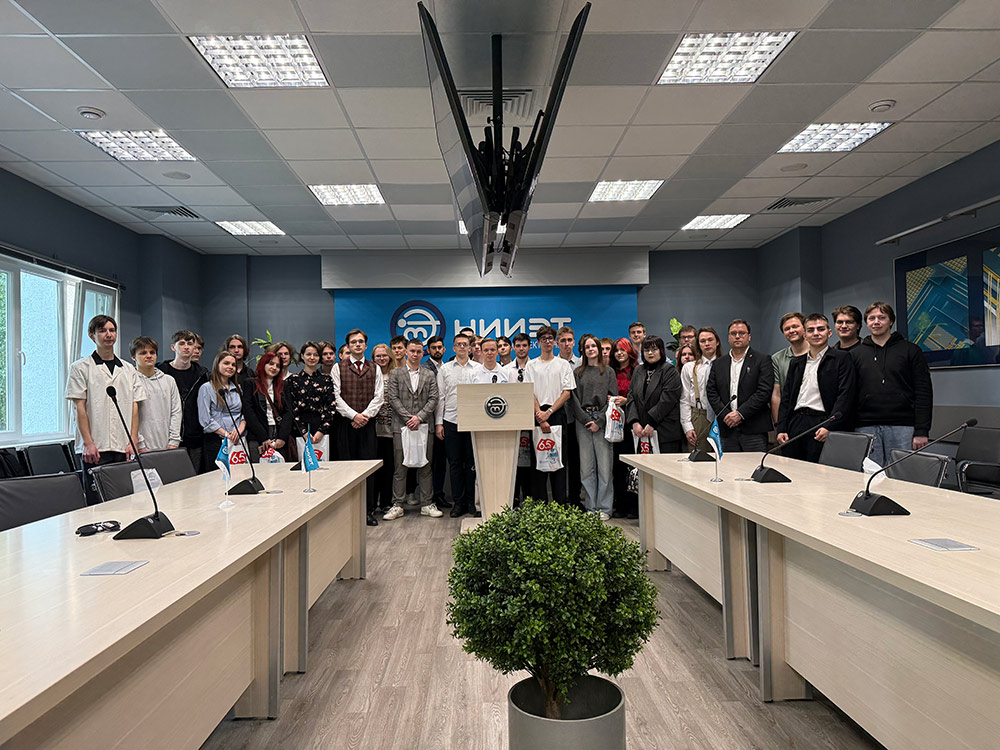
The discussion, which brought together fifty participants, turned out to be genuinely lively and productive. This open-dialogue format between aspiring scientists and experienced NIIET developers allowed them not only to discuss current projects but also to lay the foundation for future joint initiatives between the universities and the enterprise.
The participants noted the high technical standard of NIIET products, as well as their adaptability to the modern requirements of research and engineering tasks. They shared their observations on how using the institute’s products helps accelerate prototyping and reduce development costs.
At the end of the event, the leading design engineer of NIIET thanked all participants for their interest and active involvement. He noted that the meeting was meaningful and beneficial for everyone: “It is especially important to see how NIIET equipment and developments find practical application in the educational environment and become the foundation for new student engineering projects. There is every reason to believe that such meetings will become a fine tradition. A proposal has already been made to gather again next year, on the eve of NIIET’s 66th birthday, to discuss new projects, work results, and promising ideas from university students.”