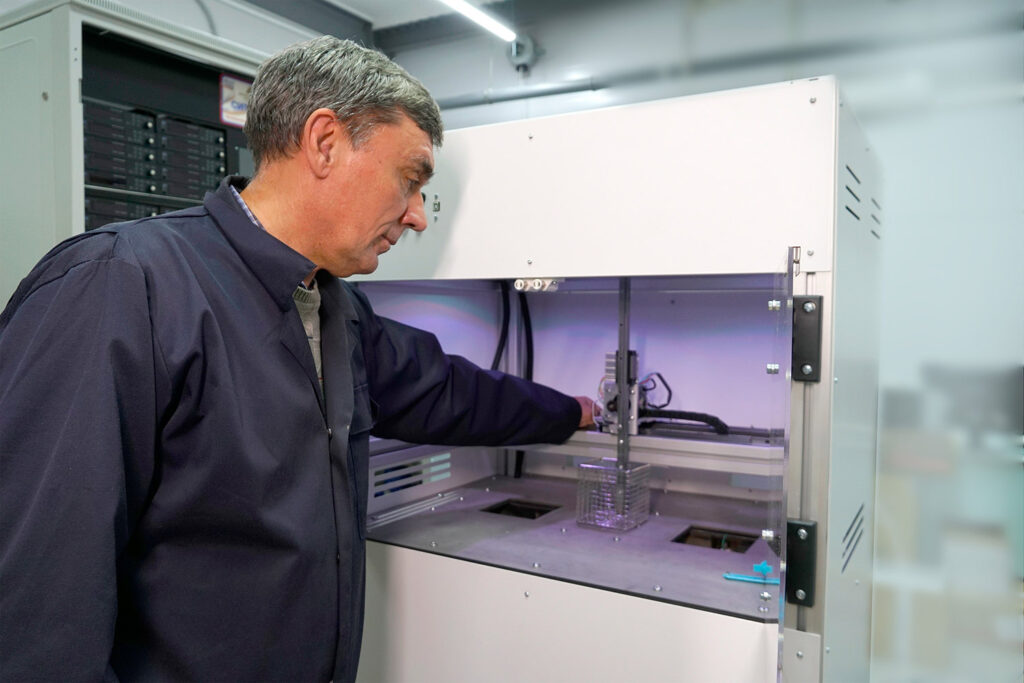
The domestic solution can work with both cheap ethyl alcohol and liquid nitrogen.
Element Group supplied testing equipment—an automatic thermal shock chamber (hereafter referred to as ATSC)—to Russian Space Systems (RSS), a subsidiary of Roscosmos, as it was told to Vedomosti by Pavel Kutsko, General Director of the Research Institute of Electronic Technology (NIIET, part of Element Group). An RSS representative confirmed the delivery. This equipment is applied for testing the resilience of electronic components to sudden temperature changes. The companies, however, did not disclose the cost of the set. As explained by Kutsko, the equipment was manufactured in accordance with RSS’s specifications. Unlike foreign counterparts that rely on expensive specialized fluids, the domestic solution uses ethyl alcohol or liquid nitrogen as refrigerants. He emphasized that his will significantly reduce operating costs.
Leonid Konik, CEO of ComNews Group explained that most global thermal chamber manufacturers use nitrogen—both liquid and gaseous—to create low temperatures. Specifically, this applies to Danble Instrument (China), Tenney (USA), and Zetatek Technologies (India). Dmitry Abrameshin, Lead Engineer at the HSE MIEM Research Laboratory of Spacecraft and Systems Historically, commented that the market was divided among large international companies: Weiss Technik (Germany), ESPEC (Japan), Thermotron (USA), and ACS (Taiwan). Their equipment was considered the benchmark and was widely used in Russia before the sanctions.
According to a NIIET representative, the delivery of the ATSC to Roscosmos took place in August 2025, but the equipment was commissioned in October 2025. RSS had never had similar installations before; testing was conducted at NIIET and other RSS partners. According to information given on the NIIET website, the first installation was completed in 2021, the production is located in Voronezh. In March 2025, the equipment was delivered to the Semiconductor Devices Plant, also part of the Element Group. “The cost of such ATSC”, as Mikhail Korablyov, Chief Designer of JSC Glonass stated it,” can range from several hundred thousand rubles up to 8 million rubles, depending on the configuration, if the cost of similar climate control equipment on the Russian market is taken into consideration. The high cost is primarily due to the technology used to manufacture such a camera: it requires high precision, specialized technologies, and expensive components”
An RSS representative specified that RSS Holding develops service systems and onboard equipment for satellites, creates antenna systems, and is responsible for research in piezoceramics (the material used in sensors) and sensors, as well as printed circuit board assembly. A reliable electronic component is essential for maintaining long-term active service life of spacecraft in orbit—15 years or more.
“In space,” explained Alexey Boyko, author of the RUSmicro Telegram channel, “any product encounters microgravity, vacuum, and temperature fluctuations ranging from 120°C to -150°C and below. Microgravity cannot be created permanently on Earth yet, but a vacuum and temperature difference can be simulated. These are the conditions a product must withstand before entering space.”
“Thermal vacuum chambers are an essential element in testing any space product—from individual devices and models to complete satellites,” Konik emphasized. “Along with thermal chambers, such products are tested on vibration rigs to simulate satellite launches and in anechoic chambers to simulate the vacuum of space. Testing itself is an important and time-consuming stage of production. Of the 2.5 to 3 years it takes to build a geostationary spacecraft, at least one year is spent on testing.”
Abrameshin continued, that such chambers cause instant thermal expansion or contraction in materials, revealing hidden defects such as microcracks in soldering or housings, delamination of contacts, and material degradation. Among those requiring this kind of equipment in one form or another are Lavochkin Research and Production Association, RSC Energia, ISS Reshetnev, TsNIIMash, and other companies that create satellites and equipment. “Similar tests are conducted, for example, in the automotive electronics or aviation industries,” Korablyov added, while Abrameshin summerized that previously, there were no fully functional Russian equivalents of such high-tech equipment, or they were inferior in automation, precision, and range.
Experts interviewed by Vedomosti did not name any domestic analogues to the ATSC system other than the NIIET chamber, so, according to them, it is difficult to estimate the market for such equipment in Russia. According to Precedence Research, the global market for test chambers was $1.15 billion in 2024 and is expected to reach $1.19 billion in 2025. Demand for such equipment is growing due to the automotive, aerospace, electronics, and pharmaceutical industries.