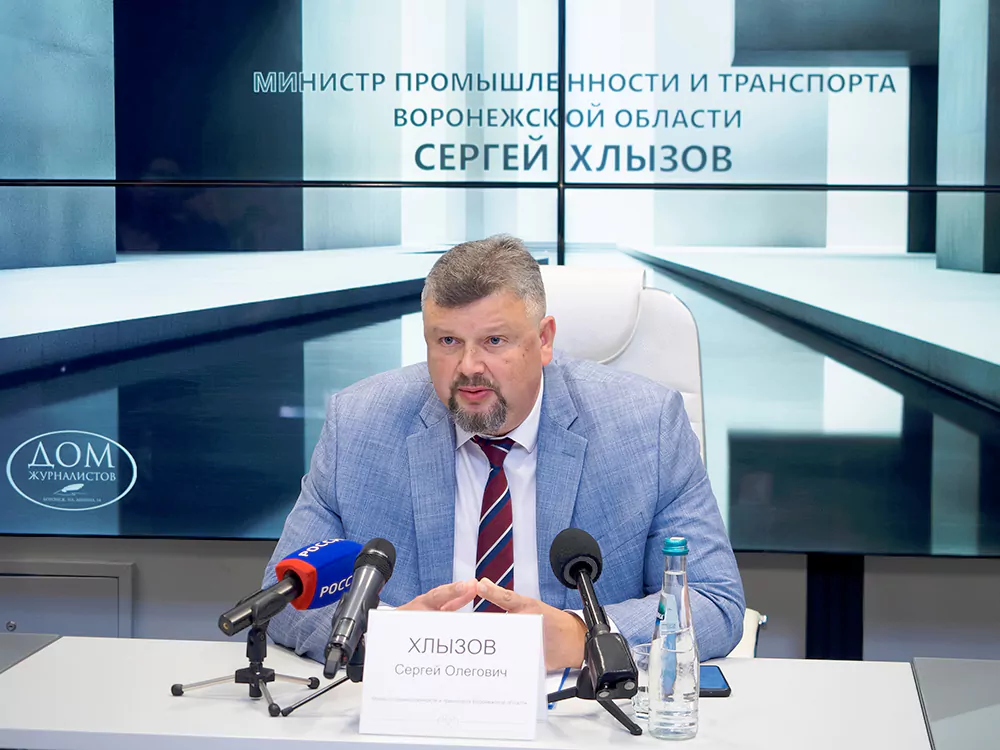
Sergey Khlyzov, Minister of Industry and Transport of the Voronezh Region, presented a report on the state of the industrial complex during his first personal press conference. Despite macroeconomic turbulence, the region maintains shipping volumes above 1 trillion rubles, registers an influx of investment in modernization, and is becoming a pilot site for implementing Russia’s first law on industrial robotization support. The minister not only elaborated on statistical improvements but also discussed hands-on management of complex assets, including such enterprises as JSC «Tjazhmekhpress», JSC KBKhA, JSC Turbonasos, and OKBM. The development of the “Academy of Industry” project was highlighted as a separate topic.
Trillion Secured: Growth Despite a Challenging Environment
Sergey Olegovich began with the key figures. By the end of 2025, shipments of products and services by industrial enterprises exceeded 1 trillion rubles (an increase of about 8%, and nearly 10% in manufacturing). The Industrial Production Index (IPI) moved into positive territory, reaching 100% overall and 100.4% in manufacturing.
In 2026, the dynamics are improving. While in the first half of 2025 the IPI dipped to 98%, it now stands at 100.5% (100.6% in manufacturing).
The Minister highlighted investment as a crucial indicator of sustainability. In 2025, capital investment in manufacturing industries grew from 22 billion to 31 billion rubles.
“This growth indicates that investment activity is sustained despite the challenging macroeconomic environment,” the speaker emphasized.
In the first half of 2026, the investment volume amounted to 8.7 billion rubles, compared to 11.5 billion rubles a year earlier. This is due to the scheduled nature of fund utilization, as the peak traditionally occurs at the end of the year.
Growth Leaders in 2025: Radioelectronics (nearly 134%) and Metalworking (110%). In the first half of 2026, the frontrunners are Chemistry (111.1%) and Fabricated Metal Products (113.1%). The Minister attributed the growth in the chemical industry to increased production of thermoplastic elastomers and the full capacity utilization of Voronezhsintezkauchuk.
Import Substitution in Action: From Catalysts to Aluminum Cans
The head of the department elaborated on the flagship investment projects. First, the opening of a production facility for an emulsion polymerization catalyst is expected by the end of the year (tentatively as early as September). Previously, this component was 100% imported. Initially, the project was planned with Chinese partners, but the company decided to implement it on its own. “This is an absolutely Russian development,” the minister emphasized.
Second, the region is counting on an aluminum can production project, which, according to Khlyzov, has no analogues in Russia’s immediate surroundings.
Cheap Money for Industry: A Focus on the IDF
The Regional Industrial Development Fund (IDF) remains the main support tool. From 2019 to 2026, 73 projects were funded for a total of 21.3 billion rubles (20 billion of which were federal funds). The plans include creating 1,639 jobs, attracting 38.2 billion in private investment, and generating 19.1 billion in tax revenues.
In 2025–2026, 15 modernization projects worth 533.5 million rubles were supported (chemical industry, oil and gas engineering), and 43 million rubles in grants were issued, including for R&D of critically important products.
Legislative Breakthrough: Robotization, Voronezh Style
The Voronezh Region is solidifying its leadership in robotization (ranking 3rd in the Russian Federation). On May 22, 2026, Russia’s first regional law supporting industrial robotization and automation projects was adopted. Bylaws are currently being drafted, with their launch scheduled for next year.
Support measures include: tax incentives and investment deductions; subsidies for equipment integration; compensation for staff retraining costs; and a new IDF loan program called “Robotization and Automation” (up to 100 million rubles).
Business interest is immense, with more than 160 enterprises ready to deploy robots, and 20 companies already participating in a free technological audit by the Federal Competence Center.
The main problem is not money, but a shortage of integrators.
“Buying just a ‘piece of hardware’ means it will remain just a piece of hardware. You need tooling, software, and training. There is a precedent where a factory tried to integrate a robot on its own and spent two years doing so. We are forming a pool of verified engineering companies,” the minister explained.
As a positive example, the speaker cited Voronezhstalmost. The enterprise began implementing robotic complexes back in 2013–2015—long before it became a mass trend. Today, its own robotization center for welding operations operates on its premises.
“They can rightfully be called one of the country’s leaders in the field of robotic welding. They are ready to train specialists who can implement projects not only at their own facility but also at other enterprises,” noted the head of the Voronezh Ministry of Industry and Transport.
Clusters and Cooperation: Betting on State Orders
The region has established 4 clusters uniting 32 enterprises, which shipped products worth 148 billion rubles. An application has been submitted to create a new interregional cluster, “AgroPromTech.” There are 7 active agreements with major companies (Gazprom, SIBUR, Rosseti, UEC, and others). The volume of shipments to these companies reached 35 billion rubles, with a plan to increase this to 40 billion in 2026.
“Tjazhmekhpress”: A School We Cannot Afford to Lose
One of the most pressing issues was the fate of the Voronezh plant “Tjazhmekhpress”—a heavy engineering school unique to the country. Historically, up to 80% of its order portfolio came from foreign consumers; however, after 2022, contracts were frozen, and the enterprise, capable of manufacturing presses with a force of thousands of tons, faced a serious capacity underutilization.
Journalists asked directly: is there a risk of losing the unique engineering and working competencies accumulated over decades?
Sergey Khlyzov responded firmly and definitively: “I can say right away: we will not let these competencies to be lost. The enterprise is truly unique. It has turned the situation around and is already in the final stages of emerging from the crisis,” the minister declared.
According to him, common ground has been found with Russian automotive enterprises, and with the ministry’s participation, cooperation is being developed with the Republic of Belarus, where there is also a significant demand for equipment of this class.
Furthermore, the region has taken the initiative to the federal level to tighten control over compliance with Resolution No. 719 (localization of production). Khlyzov explained that Chinese analog parts often slip through loopholes in the regulatory framework, which puts domestic manufacturers at a disadvantage.
“Voronezh presses are installed at Bentley and Ford factories—this is a product with a quality known not only in Russia but also abroad. Meanwhile, Chinese analogues are ‘three-year lifecycle’ machines that have to be discarded after some time. When it comes to state-owned enterprises, we must raise the question of cost-effectiveness. Our enterprise will be booked with orders for several years ahead,” the head of the regional Ministry of Industry and Transport emphasized.
Anti-Crisis Perimeter: KBKhA, Turbonasos, and OKBM Under Control
Journalists were also interested in the situation at aerospace industry, where salary delays and capacity underutilization are being observed.
Sergey Khlyzov was diplomatic but made it clear that the problems are temporary and related to bureaucratic processes within parent structures, rather than fundamental risks.
At KBKhA, problems arose due to a shift in the “Comprehensive Program for the Development of Civil Aviation.” The products have been delivered, but payments were not made due to the absence of approved legal basement.
“The program has been signed by the country’s leadership, and payments will proceed in the near future. The situation will stabilize by the end of the year, and next year the enterprise will operate steadily,” the minister assured.
Regarding the Turbonasos enterprise, the difficulties are related to Roscosmos’s internal procedures and the suspension of a number of funding projects. According to Khlyzov, the ministry is in close contact with the state corporation and sees no risks for the future of the enterprise.
The minister also mentioned the OKBM enterprise in the general context of distressed assets facing funding delays under the state defense order and related programs. As with Turbonasos, the situation is characterized as under control, and its normalization is expected once internal procedures within the parent structures are resolved.
At the same time, the minister frankly acknowledged the limited leverage of the region:
“Let’s be honest, how can a regional government help a Roscosmos structure? Through dialogue,” he noted, emphasizing that this very dialogue is now established at all levels—from the Ministry of Industry and Trade of the Russian Federation to the United Aircraft Corporation.
“Academy of Industry”: Heading Towards Digitalization and AI
Answering a question about the development of the “Academy of Industry” project launched in 2024, Sergey Khlyzov reported that the format has been deemed successful and will be scaled up.
Initially, the project was conceived as a platform to familiarize enterprises with all government support measures. It later transformed into a format of industrial tours and highly specialized sessions. The latest one, for instance, was dedicated exclusively to robotization. Now, the vector is shifting towards digital maturity.
“The next academy will most likely be dedicated to the implementation of artificial intelligence and increasing digitalization. We will invite specialized experts not only from our region but also from other constituent entities,” the minister announced. In addition, there are plans to replicate the project within the framework of the “Donbass Commonwealth,” starting with an exchange of experience with the Rostov Region.
Personnel and Technologies of the Future
The development of personnel training infrastructure continues in the region. Four educational and production clusters are operating in the fields of aircraft manufacturing and mechanical engineering, and in 2026, a new cluster is being established on the basis of the Borisoglebsk College, which will unite 6 colleges and 7 employers. The Advanced Engineering School of VSU remains the flagship for training engineers. Based on it, 5 new educational programs have been launched in the interests of the radio-electronic cluster (JSC “Concern “Sozvezdie”, JSC NIIET, and others).“Graduates will be able to develop and implement new technologies. This is a practical contribution to technological sovereignty,” Sergey Olegovich concluded.
Transport Sector
Although the primary focus was on industry, the minister also mentioned the transport sector.
Public Transport. The number of complaints from residents has decreased by a third compared to 2023. While the topic previously ranked among the top 3 issues in the region, it has now dropped out of the top five. New buses are purchased annually, and schedules are adjusted to accommodate peak morning and evening loads.
Intercity Transportation. Khlyzov acknowledged that there had been instances of terminating contracts with unreliable carriers. The ministry has intensified efforts to include such companies in the registry of unscrupulous suppliers. “Backup options are always available,” the minister assured.
Railways. The redirection of freight flows from the southern route is proceeding as planned, in accordance with the approved schedules of Russian Railways (RZD).
Metrobus. Commenting on complaints regarding the quality of lane dividers (delineators) and bus shelters, the minister stated that the bus stops are designed quite well, and the problem of vehicles riding over the dividers will be resolved by equipping the line with traffic control cameras. “Once the first fines start coming in, everyone will stop driving there,” Sergey Khlyzov summarized.
PHOTO: “Voronezh House of Journalists”
Source: Industrial News
https://promvesti-vrn.ru/events/investitsionnyy-razvorot-voronezhskaya-oblast-uderzhivaet-planku-trilliona-rubley-i-gotovit-zakonoda/