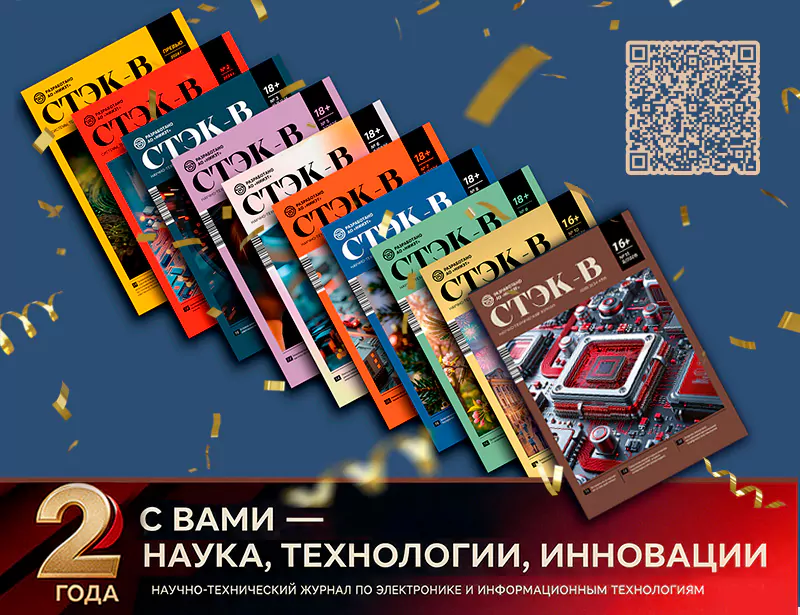
Over this time, the publication has brought together 175 authors – from leading scientists and engineers in the electronics industry to professors and students of specialized universities. More than 140 scientific articles that have passed a full cycle of independent peer review have been published in 11 issues.
Pavel Kutsko, Editor-in-Chief of “STEK-V” and CEO of JSC “NIIET”, noted that the journal was initially oriented towards the demands of the real sector of the economy: “Today, I would define ‘STEK-V’ as a platform for dialogue between the scientific community, engineers, and enterprises of the radio-electronic industry. When the journal was being created, we proceeded from the premise that modern microelectronics is not enough to exchange only theoretical results. It is important that research be directly linked to real engineering tasks – design, production technologies, testing, and the implementation of new solutions. Therefore, in the journal, we try to combine scientific articles, applied engineering developments, and materials dedicated to practical issues of the industry.”
Among the key thematic areas of “STEK-V” are microelectronics and electronic component base (ECB), design automation, digital technologies, mathematical modeling, and artificial intelligence.
A separate area of the editorial board’s work is supporting young specialists. Students, postgraduate students, and novice developers get the opportunity to present the results of their research to the professional community and gain experience in preparing scientific publications, taking into account the requirements of an industry scientific publication.
At the same time, the key criterion for evaluating materials is the practical applicability of the research results.
“Production is primarily interested in solutions that can be applied in practice: increasing the reliability of a product, reducing design time, simplifying the technological process, improving characteristics, or reducing costs. Therefore, it is important to clearly show the initial problem, the proposed approach, and the result obtained in the article. If there are experimental data, modeling results, comparative characteristics, or a prototype model, they should definitely be provided. A good technical article should allow a specialist to understand not only what was done, but also how applicable this solution is in real production,” emphasized Pavel Kutsko.
The main result of the two years of “STEK-V” work is the creation of a platform where scientists and engineers exchange experience and together create solutions for the electronics industry. The next stage is strengthening the applied component of publications, developing partnerships with enterprises on a parity basis, and exchanging experience with researchers from friendly countries.
The journal is distributed by subscription, delivered to scientific libraries and specialized universities, presented on the Ozon marketplace, as well as at industry exhibitions and events of JSC “NIIET”.