RISC-V DEVBOARDS is the nation’s first early access program providing engineers and developers with the opportunity to work with promising domestic RISC-V architecture microcontroller solutions. The program is implemented in several stages, each making products from Russian ECB (electronic component base) manufacturers available for professional evaluation.
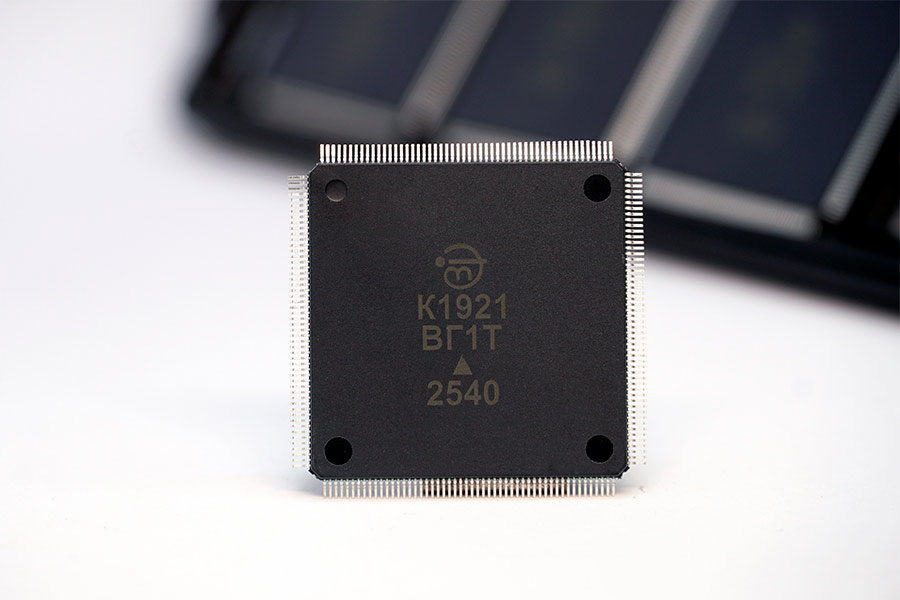
As part of this new stage, participants will gain access to the latest K1921VG1T microcontroller, developed by the Scientific Research Institute of Electronics (NIIET, part of the Element Group, MOEX: ELMT).
Participants will be provided with development boards featuring installed chips, peripherals, and software to test functionality and develop their own solutions.
The K1921VG1T is a dual-core 32-bit RISC-V microcontroller designed for automated process control systems and industrial systems
This product is the most powerful in NIIET’s RISC-V microcontroller line-up. Furthermore, the K1921VG1T is the institute’s first development to feature dual cores capable of operating in lockstep mode, with 10/100/1000 Ethernet interface support, and a wide range of internal diagnostics and error-correction mechanisms.
Key Microcontroller Specifications:
• Nominal Supply Voltage: 2.8 V – 3.3 V
• Operating Temperature Range: -40°C to +105°C
• Core Frequency: Up to 204 MHz
• CPU: Dual-core 32-bit with DSP instruction support
• Memory: 4 MB main Flash memory and 512 KB additional Flash memory with ECC (Error Correction Code)
• Networking: 10/100/1000 Ethernet controller with integrated PHY (Physical Layer)
• CAN Controller
• Cryptography: Cryptographic hardware accelerator supporting AES-128, AES-256, Kuznyechik, and Magma algorithms
• Debug Interface: JTAG
RISC-V is a modern open-source processor architecture standard that is globally popular and used to create microprocessors for all classes of devices.
The RISC-V DEVBOARDS early access program is based exclusively on domestic developments. Its goal is to promote Russian RISC-V microcontroller solutions across various industrial segments, educational institutions, and the student and innovator communities.