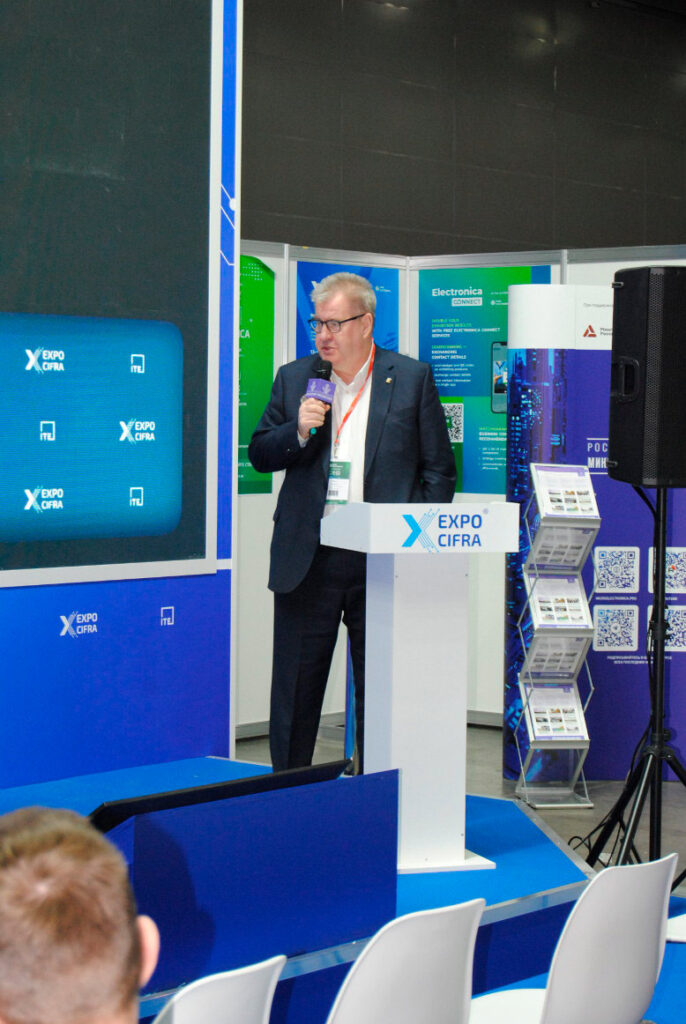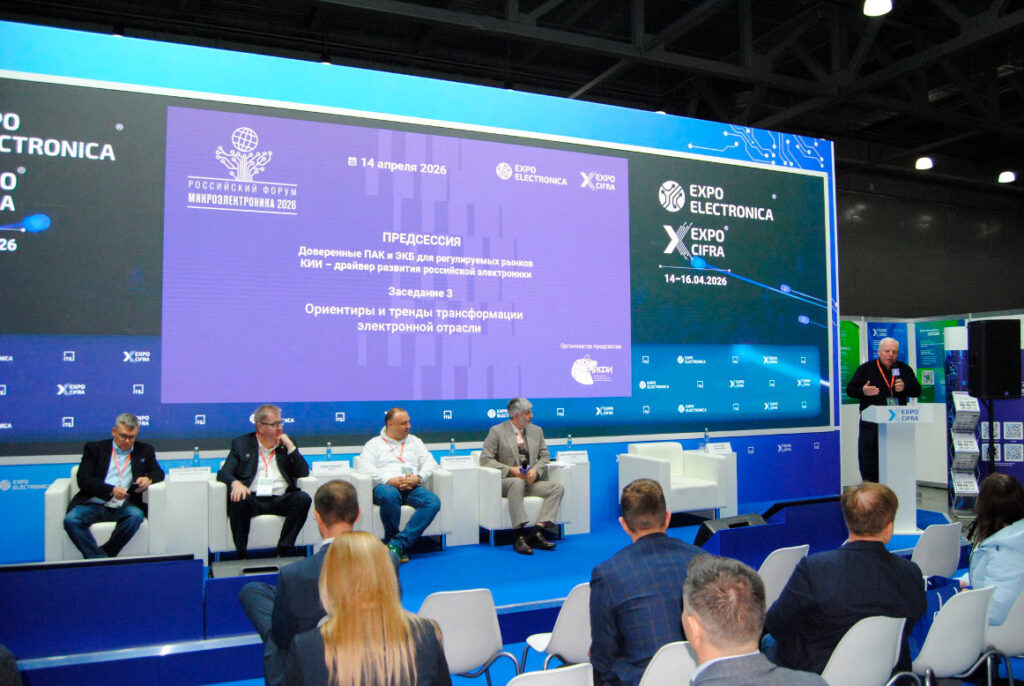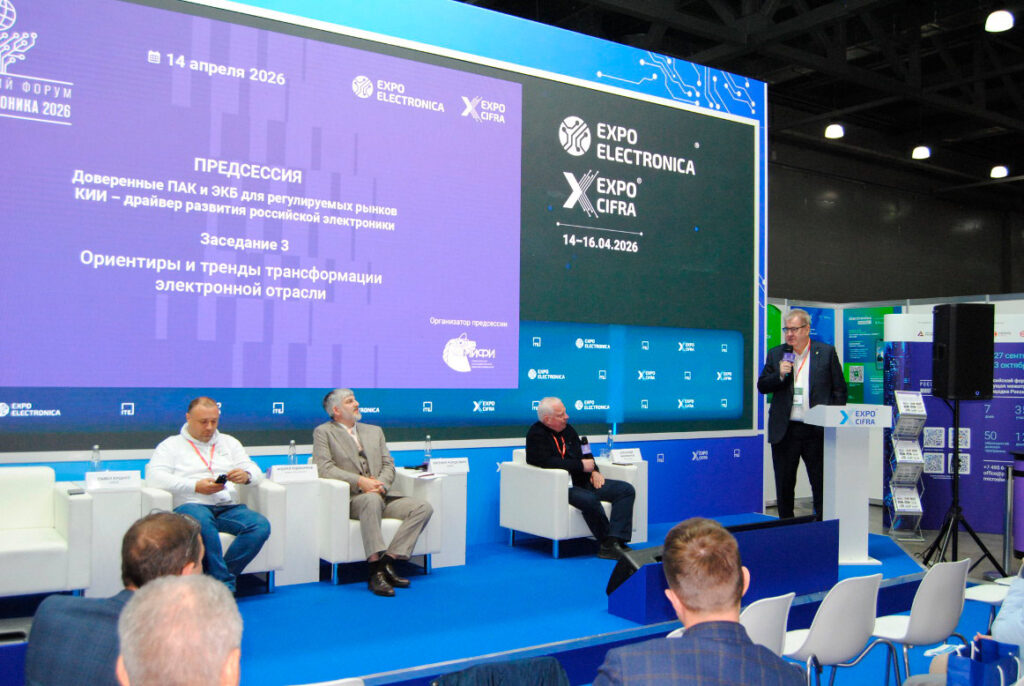
As part of the ExpoElectronica 2026 business program, a pre-session of the Russian ‘Microelectronics’ Forum was held on the topic: “Trusted Hardware-Software Packages (HWP) and Electronic Component Base (ECB) for Regulated CII Markets – A Driver for the Development of Russian Electronics.” The pre-session was chaired by Professor Alexander Nikiforov of NRNU MEPhI and consisted of three meetings. During the session focused on landmarks and trends in the transformation of the electronics industry, reports were presented by the moderator, Evgeny Mordkovich (representing FSBI VNIIR), as well as Andrey Evdokimov (Baikal Electronics), Anatoly Korsakov (Tramplin Electronics), and Pavel Kutsko, Head of JSC NIIET (part of the Element Group, MOEX: ELMT).
In his speech, Pavel Kutsko outlined several key issues regarding the assurance of trustworthiness in domestic ECB and trust in its manufacturers, as viewed from within the industry—specifically from the perspective of the enterprises creating Russian electronic components.
In particular, it was noted that for many consumers, the trustworthiness of ECB continues to be associated primarily with the presence of a military representative office at the enterprise. However, according to the speaker, to achieve high product quality, functional compliance, and other factors that directly influence customer trust, it is first necessary to create an effective quality control system that is not dependent on specific individuals.
The importance of mutual understanding between the regulator and industry enterprises was also emphasized. Drawing on his experience at the Ministry of Industry and Trade of Russia, FSUE MNIIRIP (now FSBI VNIIR), and various electronics companies, Pavel Kutsko pointed out that many problems look different from the regulator’s position compared to the viewpoint of the ECB designer and manufacturer. He suggested on-site training of regulatory staff at active manufacturing plants could foster better mutual understanding and, consequently, mutual trust.
Additionally, the report addressed the issue of re-labelling foreign ECB to pass it off as a Russian-made component, a practice which clearly undermines the level of trust in such products.
The report’s central thesis stated that only the phased localization of ECB production would lead to true trustworthiness, and that this process should begin with the manufacturing stages currently available within the country. It is impossible to build and operate a profitable wafer fabrication plant (fab) without existing demand; however, if requirements were introduced mandating the use of integrated circuits with “Level 2” localization, this could eventually generate the demand necessary to take the next step—investing in wafer production.
It was also proposed that the task of verifying IC trustworthiness should be assigned to enterprises performing chip packaging and assembly, as all IC dies assembled in Russia pass through these facilities.
Both the speakers and the audience engaged in an active discussion on several issues related to ECB security and the current challenges faced by domestic designers and manufacturers. Specifically, varying opinions were voiced regarding the line between the re-labelling of foreign products and technology transfer, and how this affects market accessibility for Russian design centers.
During the debate, Pavel Kutsko argued that for the successful development of domestic ECB, the state must provide not only financial support but also stricter requirements for the mandatory use of Russian components. In his view, these requirements should be universal, with a clearly defined and finite list of exemptions for sectors where the use of domestic ECB is objectively impossible. Currently, the situation is reversed: requirements are set only for specific sectors, meaning that the presence of a mandate is essentially treated as an exception rather than the rule.
Other topics raised during the event included the demand for Russian microprocessors and microcontrollers, the capacity of domestic manufacturers to meet this demand, state support for ECB development, and the level of trust in Russian solutions among end-equipment manufacturers and consumers.