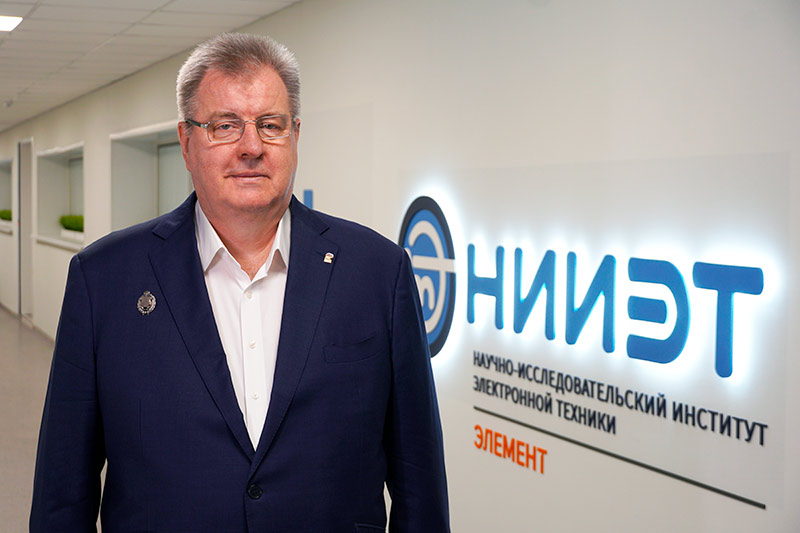
Marking its 65th anniversary, the Scientific Research Institute of Electronics (NIIET, part of Element Group, MOEX: ELMT) has advanced its production of RF devices, power semiconductors, and microcontrollers while expanding manufacturing capacity. Pavel Pavlovich Kutsko, the General Director, revealed the Company’s achievements for this period, talked about the impact of state support, and shared strategies that might help to increase demand for domestic electronic components.
Pavel Pavlovich, JSC “NIIET” celebrates its 65th anniversary this year. You have been leading the enterprise for almost six of those years. How would you characterize this period in Company’s history?
JSC “NIIET” is a mirror of the domestic electronics industry. This might sound grand, but the fact remains: especially in recent times, the development of our institute has been closely linked to the development of the industry as a whole and state policy in this area. Of course, NIIET is not in a unique position here; the same applies to the other enterprise I manage—JSC “NIIMA Progress”—and many other companies and organizations in the sector. Under the current conditions, most enterprises are developing in much the same way. Naturally, the roles of the leader’s personality, the owner, and the enterprise’s team still matter. One cannot overlook the company’s ability to lobby for its interests or its capacity to convey its position to industry leaders and strategic decision-makers. There are many individual aspects affecting the development of a specific enterprise. However, overall, they are all moving along the same path, and each reflects the general situation in the industry while serving as a source of feedback for implementing the industry-wide development strategy.
Speaking about recent years, several factors influenced our institute’s development during this period. I joined JSC “NIIET” in 2020 and consider myself fortunate to have taken charge of the enterprise at that time. It was a very interesting period. On one hand, it was a time of shifting focus from specialized electronics to the civilian sector. On the other hand, it was a time of unprecedented state support for the industry. While “old” funding tools like R&D financing and targeted programs remained, new support measures emerged. These allowed us to take a massive step forward in developing competencies, expanding our product range, creating new, high-demand components, and strengthening the enterprise’s production capabilities.
I can say that we are proud of what has been achieved over these five-plus years and that the enterprise has earned the industry’s respect during this time. We have evolved from an “average” component developer into a leader in the Russian market for creating microcontrollers based on the open RISC-V architecture, as well as RF and power semiconductor devices, particularly those based on gallium nitride on silicon (GaN-on-Si). I believe we managed to correctly leverage state support opportunities and, partly with their help, achieved results that we are proud to showcase and that have already gained recognition among Russian equipment developers.
You mentioned that the development of JSC “NIIET” and other enterprises reflects the growth of the domestic electronics industry. In your opinion, how effective have the support measures, particularly subsidies, been overall during this period?
An assessment of the impact and effectiveness of these support measures on the industry is actually being conducted right now. There is an ongoing reflection on whether the work in recent years was structured correctly.
The results are probably mixed. If we talk about NIIET, the conclusions are entirely positive. The issue of demand for certain products and achieving projected revenues is not yet fully resolved, but it is clear now that this is just a matter of time. Moreover, we are not talking about a distant future; this issue will most likely be resolved within one to two years.
There are probably examples of inefficient use of state support measures as well. But nothing is ever perfect. On April 12, our country celebrated the 65th anniversary of Yuri Gagarin’s flight. Naturally, before Vostok launched the spacecraft with the first cosmonaut into orbit, several test launches of this type of rocket had been carried out, and not all of them were successful. What would have happened if the country’s leadership had decided to abandon the space program after the very first—or any subsequent—accident? Would we have been the first in space?
There is no moving forward without making mistakes. That is why I believe every enterprise in the industry should have the right to fail. Without it, there will be no breakthrough projects, and no one will take bold steps. Under current circumstances, a mistake can lead to multi-million-dollar lawsuits and the risk of a complete shutdown of operations. Of course, dishonest entities must be held accountable and sanctioned. But where will we end up if, without understanding the circumstances, we deny enterprises the opportunity to continue working after a mistake is made, or worse, punish them? It is very easy to extinguish the fire in a developer’s eyes…
I am not speaking about anything in particular right now. These are abstract reflections, especially since our enterprise, as I have already mentioned, used the support measures very effectively. However, the risk for industry players does exist, and the evaluation of their actions must be approached with great caution. In this context, on one hand, it is good that law enforcement agencies thoroughly investigate every case of inefficient subsidy use. On the other hand, it would be desirable for punitive decisions to be made with the involvement of specialists who understand the industry’s specific technical and technological nuances.
For instance, in the field of microelectronics today, achieving results from a single wafer run is sometimes almost treated as a requirement to minimize costs. But in reality, such an outcome can be compared to a miracle. It is practically impossible to get a successful result from the very first run, and industry specialists know this well. However, those who oversee the industry or operate adjacent to it might not be aware of this. Therefore, in my view, it would be correct to give the key role in making decisions regarding penalties for the inefficient use of subsidies to the relevant regulator—in this case, the Department of Radio-Electronic Industry of the Ministry of Industry and Trade of Russia.
What you said concerns the failure to meet technical requirements. However, enterprises that received subsidies, for instance, under the Decree of the Government of the Russian Federation No. 1252 dated July 24, 2021, also committed to specific revenue volumes from the sales of the developed products.
Revenue requirements are a completely different story. There was a period when everyone was talking about end-to-end projects. The underlying idea was correct—the cooperation chain in such projects was supposed to be built from the start of component development all the way to its final application. However, for one reason or another, this concept was implemented only to a very limited extent.
To this day—and this is being discussed at various levels—the issue of demand for electronic products has not been fully resolved. An excellent, innovative product is developed, matching global standards, but then a struggle begins to get it implemented in specific types of equipment, competing against imported and pseudo-domestic products. We have to compete not only on quality, delivery times, and so on, but also on price. Russian developers of new electronic products, initially placed on an unequal footing with foreign manufacturers, have to fight through this competition entirely on their own.
The best-selling product of JSC “NIIET” and the first in our line of RISC-V-based microcontrollers—the 32-bit ultra-low-power microcontroller K1921VG015—was originally developed for smart electricity meters. The regulatory framework defining the requirements for using domestic microcontrollers in these devices had been created even before we started developing this IC. That is probably why we took on this project. However, although we have successful examples of the K1921VG015 being used in electricity meters, we are still forced to fight for this market today against significantly cheaper Chinese components or those mimicking domestic ones. This is despite the fact that our microcontroller meets all the requirements for a domestic IC, with the sole exception of the current gap in wafer fabrication: the design is completely ours, based on an open-architecture core, and packaging and testing are done at our facility.
One of our customers even told us the exact amount they lose annually by using our microcontrollers instead of counterfeit Chinese ones, which turn out to be twice as cheap.
And this is a well-known vicious circle: the lower the volume of consumption, the higher the production cost, and therefore the price; and the higher the price, the lower the volume of consumption. We are ready to manufacture microcontrollers in fairly large quantities. Our capacities for wafer thinning and dicing, IC packaging into plastic packages, and testing are designed for 10 million units per year. We can increase production volume by running more shifts. We are ready to install additional equipment to boost volumes even further if we see the demand. However, this demand is low, even though the number of manufactured electricity meters clearly exceeds the total number of microcontrollers supplied by Russian manufacturers.
It is clear that commercial companies have always prioritized, and will continue to prioritize, profit, and therefore they will always strive to design into their products the cheaper components. For instance, in one of the application areas— I am no longer referring to metering devices—the demand for microcontrollers, which are functionally identical to ours, is around 40 million units per year. However, there are no requirements to use domestic microcontrollers in this field, so Chinese ICs are used there, which are more than 30 times cheaper!
We can see that the Ministry of Industry and Trade of Russia, together with the Association “Consortium of IC Design Centers and Radio-Electronic Industry Enterprises”, is doing a lot to prevent counterfeit products from entering into the Registry of Russian Industrial Products. Extensive work is underway to expand and tighten the requirements of Decree of the Government of the Russian Federation No. 719 dated July 17, 2015. This work gives certain results. However, it does not lead to a turning point in the situation. And since the situation does not change significantly despite these efforts, it probably means that something is being done wrong.
What could be done to break this vicious circle?
I believe that under current circumstances, the only way forward is to introduce strict requirements for the mandatory use of domestic electronic components in equipment in order for it to be recognized as Russian-made. Right now, Decree No. 719 is constantly changing, and a points-based system is being introduced for more and more product categories and types. At the same time, each sector has its own requirements, and the manufacturers of the respective equipment have a direct influence on shaping them. Essentially, the consumers of electronic components are writing the rules for themselves on how much and what kind of domestic components they must consume. Furthermore, everything that falls outside the scope of this decree is not regulated at all in terms of using Russian components.
I propose to turn this situation around. In my opinion, Decree No. 719 should fit on a single page, and the main localization requirement regarding electronic components should be expressed in a single phrase: for example, 60% by 2030, and 95% by 2035. Opponents of this idea say that there are areas where achieving such figures will be impossible for objective reasons, as certain technologies will not become available to us by those deadlines. This is true. But let us define those areas and make exceptions for them. In other words, the rule should be a set percentage of domestic components, and the exception should be a permission to use foreign components where the use of domestic ones is impossible—not the other way around, as it is structured now.
The current state of affairs also negatively impacts how willingly enterprises engage in new component development projects and how ready investors are to fund them. When there is no clear understanding of the market prospects for a developed product, and consequently, no clear return on investment, entering such projects is naturally seen as risky.
I perfectly understand that the approach I am proposing will face resistance from equipment manufacturers and entire industry consortium—be it in computing, telecommunications equipment, or automotive electronics… But if there is no incentive to use domestic electronic components, they will not be used. In the current situation, there is no economic incentive because it is impossible to compete with China on production costs. This means there must be a regulatory incentive. If there is another way that does not involve strict regulatory requirements, let us discuss it. But in my view, there is no other way right now. Let me remind you, by the way, that back in 2016, the Guaranteed Procurement Plan for Russian civilian microelectronic products was approved, yet it was never implemented.
It is critical that the issue of demand for domestic electronic components is resolved. This is the key question. We want to finally move from establishing to flourishing at last.
Could a mechanism like subsidizing the price difference between domestic and foreign electronic components help in this case?
There has been a successful example of applying this mechanism: the state, represented by the Ministry of Industry and Trade of Russia, covered the price difference for bank card chips. However, this approach, unlike the regulatory requirements for the mandatory use of domestic electronic components that I mentioned earlier, should be utilized for specific applications. This requires an analysis of the funding volume needed for each specific case. You cannot introduce such a subsidy for microcontrollers in general, but you can for microcontrollers used in electricity meters. Of course, this will not solve all the meter manufacturers’ issues, but the price-related problems will be temporarily alleviated.
If, at the same time, we define a traceable plan for reducing the price of the respective electronic components as consumption grows—and consequently, reducing the subsidies—it is quite possible that at a certain point, consumers will have an economic incentive to use Russian components without any subsidies. Even if the price of the domestic solution remains slightly higher than that of the imported one, consumers who have worked with Russian component manufacturers will likely appreciate their other advantages: the lack of a language barrier, technical support, accessibility, delivery times, and so on. This could also serve as a factor for a further increase in demand for domestic electronic components.
This brings to mind your presentation, which you repeatedly showed at various events a few years ago, titled “The Nine Circles of Hell of Using Domestic Electronic Components.” As I recall, those circles included issues with both support and availability…
That is absolutely correct. Those circles included the lack of databases with technical specifications for Russian components, a shortage of technical documentation and development tools, and difficulties with the availability of both evaluation samples and mass products, among other problems. Undoubtedly, resolving these issues brings us closer to success, and there is progress in this direction.
In our company, we pay great attention to these matters. For the microcontrollers we manufacture, we offer evaluation boards that allow engineers to quickly assess the capabilities of the respective IC, create a prototype device based on it, and test the circuit design and software. Detailed documentation for most of our products is available on the JSC “NIIET” website, software development tools for microcontrollers are uploaded to repositories, and we are constantly working to expand the range of available information on our products and tools for developers.
Recently, we held a series of seminars on the rapid adoption of various components manufactured by JSC “NIIET,” and people showed great interest. For example, the seminar “New RISC-V Architecture Microcontrollers from NIIET,” dedicated to the K1921VG1T, K1921VG3T, K1921VG5T, and K1921VG7T ICs, which took place on December 11, 2025, brought together 640 participants. And this was not a kind of seminar where participants are offered a free lunch and taken on sightseeing tours around Voronezh. People attend such events solely to gain information and understand the feasibility of using domestic products in their designs.
Let us estimate what kind of payback can we expect from this seminar. Out of 640 participants total—even assuming some joined by chance, and some enterprises sent two people instead of one—the seminar must have gathered representatives from about 200–300 curious enterprises. A massive interest in our products was evident at the event, and we received very good feedback. It would seem that at least 100–150 companies should have reached the stage of signing a supply contract by now—long-term, short-term, forward, or any other kind. But that did not happen. Why? It remains unclear to me for now. Clearly, some additional tool is needed to break this deadlock.
Your enterprise is one of the few among domestic component manufacturers to sell its products at retail. Is this a branding initiative, or does it serve other purposes?
It is probably a branding initiative first and foremost. It was meant to highlight the availability of domestic microcontrollers. After all, most imported components can be easily bought on marketplaces and in specialized stores, whereas Russian components are usually quite difficult to find. People have grown accustomed to this, and a corresponding stereotype has been formed. Changing this stereotype was one of our main goals when we launched retail sales of our microcontrollers.
At the same time, there are amateur technicians who initially use a component for personal projects but may later apply it in their professional work. There are also students who try out different options now and will rely on them in the future when they become engineers. So, there is a practical component to this initiative as well.
Furthermore, people share their experiences. After trying out a component purchased as an experiment, they often write reviews and overviews on specialized platforms. By the way, according to my observations, on Habr—where authors do not hold back on negative ratings—the reviews of our microcontrollers are predominantly positive. And if a device built on our IC is described on such a resource, even if it is a single prototype, it already serves as a positive example of real-world use. Moreover, those who buy our controllers at retail are independent individuals. They are not bound by regulatory requirements to use domestic components, nor are they accountable for the funds spent on purchasing them. The opinion of such people is particularly valuable to those who subsequently make decisions on using specific components, as it is perhaps the most objective, especially regarding the technical features of our products.
I believe that positive cases of product application and pilot projects are incredibly important. We discussed subsidizing the price difference between domestic and foreign products. The fact that this was done for card chips is one such positive examples, showing that this mechanism is workable and can be used in other areas.
The same is with domestic components. For instance, at the recently held ExpoElectronica exhibition, we held meetings with companies that design and manufacture electricity meters. Not all of these meetings were successful. However, some manufacturers stated that our microcontroller 100% fulfills their needs and that they will be using it in their entire product line. These are the kinds of stories that need to be shared, because when positive examples exist, there is a desire to replicate them. When they are missing, taking that first step is difficult. Not everyone is willing to be a pioneer.
The retail availability of JSC “NIIET” microcontrollers also contributes to the emergence of new successful use cases. Granted, we do not sell a massive volume of components through retail, even though we offer packs of 16 and even 32 microcontrollers. However, it indirectly exerts a positive impact on our overall sales as well.
In recent years, JSC “NIIET” has significantly expanded its manufacturing capacities. The microchip production facility underwent technical re-equipment, a packaging line for components in plastic packages was launched, and recently, the institute embarked on a project to establish a post-growth fabrication of gallium nitride on silicon (GaN-on-Si) devices. How is this project going on?
There is progress in this direction. The development of design and cost estimation documentation has been completed, and equipment suppliers have been selected. Work in the field of GaN technology also continues in collaboration with Voronezh universities within the framework of Advanced Engineering Schools and laboratories. However, we have not yet moved on to the investment phase. I hope that the relevant decision will be made shortly, and we will be able to actively move toward the goal set for this project—creating a full-cycle post-growth production facility for gallium nitride on silicon semiconductor devices.
I should note that we have development plans not only in the field of gallium nitride. You have also mentioned our assembly production line, and I consider it a highly successful project. Not everyone, who attempted to set up such a facility on their premises, succeeded. Currently, I believe our packaging line is one of the most active—if not the most active—in our country. In the process of implementing this project, we acquired strong competencies in organizing component packaging operations, and we are ready to develop this area and expand capacities.
There is a lot of talking right now about protecting Russian manufacturers and how those who create pseudo-domestic products hinder them. At the same time, it is not a common global practice for microelectronics assembly facilities to be created within individual companies that design or manufacture chips. Usually, these are large enterprises specializing in IC packaging and testing that provide these services on a contract basis—the so-called OSATs (Outsourced Semiconductor Assembly and Test). Our idea is to create one or several such companies in Russia and grant them the right to assess the “domestic origin” of the ICs they package. Recently, amendments were made to Decree No. 719, according to which points for second-level integrated circuits are awarded, among other things, for performing packaging and testing within the Russian Federation. If a die undergoes these operations at such a contract manufacturer in Russia, why not give that manufacturer the ability to determine how well the die complies with the requirements of this decree? This is a very simple approach to implement, and it would separate the wheat from the chaff in practically all cases.
Moreover, if we are pursuing the path of IC localization, it makes sense not just to award points for operations performed within our country that have already been mastered here, but to make this mandatory for an IC to be recognized as domestic.
I am not saying that there should be only one such OSAT enterprise, or that NIIET specifically must become it. However, we are ready to take on this role. We possess the necessary foundation and relevant experience for this, and we are prepared to scale our production for this task. Furthermore, we are ready to bear responsibility for the results of verifying compliance of the packaged products with the requirements for second-level integrated circuits, making sure that an imported product will not be passed off as Russian.
In addition, if we are talking about volumes of around 50 million ICs per year—which is the exact volume currently consumed by the domestic civilian industry—scaling our production would require relatively small investments. According to our estimates, it is about 5 billion rubles. And the time required to implement this project would be just 1.5 to 2 years.
A little over three years ago, the Union of Electronic Industry Enterprises of the Russian Federation “Russian Electronics” was established at your initiative. Has this idea paid off? To what extent has this community succeeded in uniting the industry?
Frankly speaking, when this community was being created, I expected greater interest from industry enterprises, as I believed that this platform would serve as a space to jointly discuss and resolve the problems that companies face in their daily operations. Unfortunately, it turned out that these issues can only be discussed under conditions of strict confidentiality, and resolved only within the framework of official expert organizations and executive branch councils.
I will go even further: it is difficult to unite even the enterprises of a single city. Each of them has its own interests and its own owner with specific requirements. And the most disappointing thing is that very few are willing to openly express their position. Extremely few.
However, speaking up and voicing your position is essential. I know from my own experience that the industry leadership does hear us and, one way or another, takes our opinions into account when making decisions. But they can only hear us if we speak out loud.
What goals do you see for yourself in the near future? What are you focused on right now?
Answering this question is very simple. In January of this year, the President of the Russian Federation held a meeting on the development of microelectronics, so resolving the tasks that he set for the industry is our main priority right now. These tasks are very timely. Fulfilling them will allow us to move forward with greater confidence.